Anthropic shipped Claude Design yesterday. Figma stock dropped seven percent before the keynote was over. That's the story everyone wrote. I don't think it's the interesting story.
The feature worth paying attention to isn't that Claude can now make slides. It's that Claude can ingest your codebase and your design files during onboarding, build a design system from what it finds, and then apply that system to everything it produces from there forward. That's a different product than "AI makes pretty pictures on demand." And it's a different trajectory.
What It Is#
Let me explain what Claude Design actually is, briefly, because most of the launch coverage is thin. It's an Anthropic Labs product, powered by Opus 4.7, that you get through the palette icon on the left sidebar of Claude.ai if you're on Pro, Max, Team, or Enterprise. You describe what you want (prototype of a meditation app, deck for a board meeting, one-pager for a product launch) and Claude produces a rendered artifact. Export to Canva, PDF, PPTX, standalone HTML, or hand off to Claude Code.

The Part Everyone's Covering#
The obvious frame is that this is a Figma threat. It's not. Figma is a collaboration tool for professional designers working in a team. Claude Design is for the product manager at 11 PM who needs to show three wireframe options in tomorrow's standup and has never touched Figma. Those are different users. The seven percent dip reflects a reflex, not a substitution.
Same for Canva. Anthropic shipped an explicit Canva export path on launch day, and Melanie Perkins put out a positive statement. They're playing it as complementary, and it mostly is. Canva's moat was the template library and the distribution. AI generation doesn't kill that.
The Part I Care About#
Here's what's actually new.
Most "AI design" products so far have been one-shot generators. You type a prompt, you get an image. The output looks fine in isolation and looks nothing like your actual product. Anyone who's tried to use Midjourney or ChatGPT image gen for real product work has hit this wall. The output is generic because it has to be. The model doesn't know what your buttons look like, what your typography is, what your brand colors are.
Claude Design solves this at onboarding. It reads your codebase and your design files. It extracts your colors, your type, your component patterns. Then it builds a design system internally and uses it on every project from that point on.
That is a meaningfully different product. It means the wireframe of your checkout flow uses your checkout flow's buttons. The pitch deck uses your brand's type hierarchy. The one-pager ships with your actual palette, not a Claude-default palette that vaguely resembles it.
This is context ingestion applied to design. Which, if you've been paying attention to the shape of Claude Code and the various "feed your repo to the model" patterns, is the same motion repeated on a new surface.
Generation Is One Mode. Refinement Is Another.#
You can see the second shift in the product itself. It doesn't just spit out a globe. It spits out a globe with a Tweaks panel: theme, breakpoint, arc color, arc width, arc glow, density, pulse speed. Live parameters you manipulate on the rendered artifact instead of regenerating from a prompt.
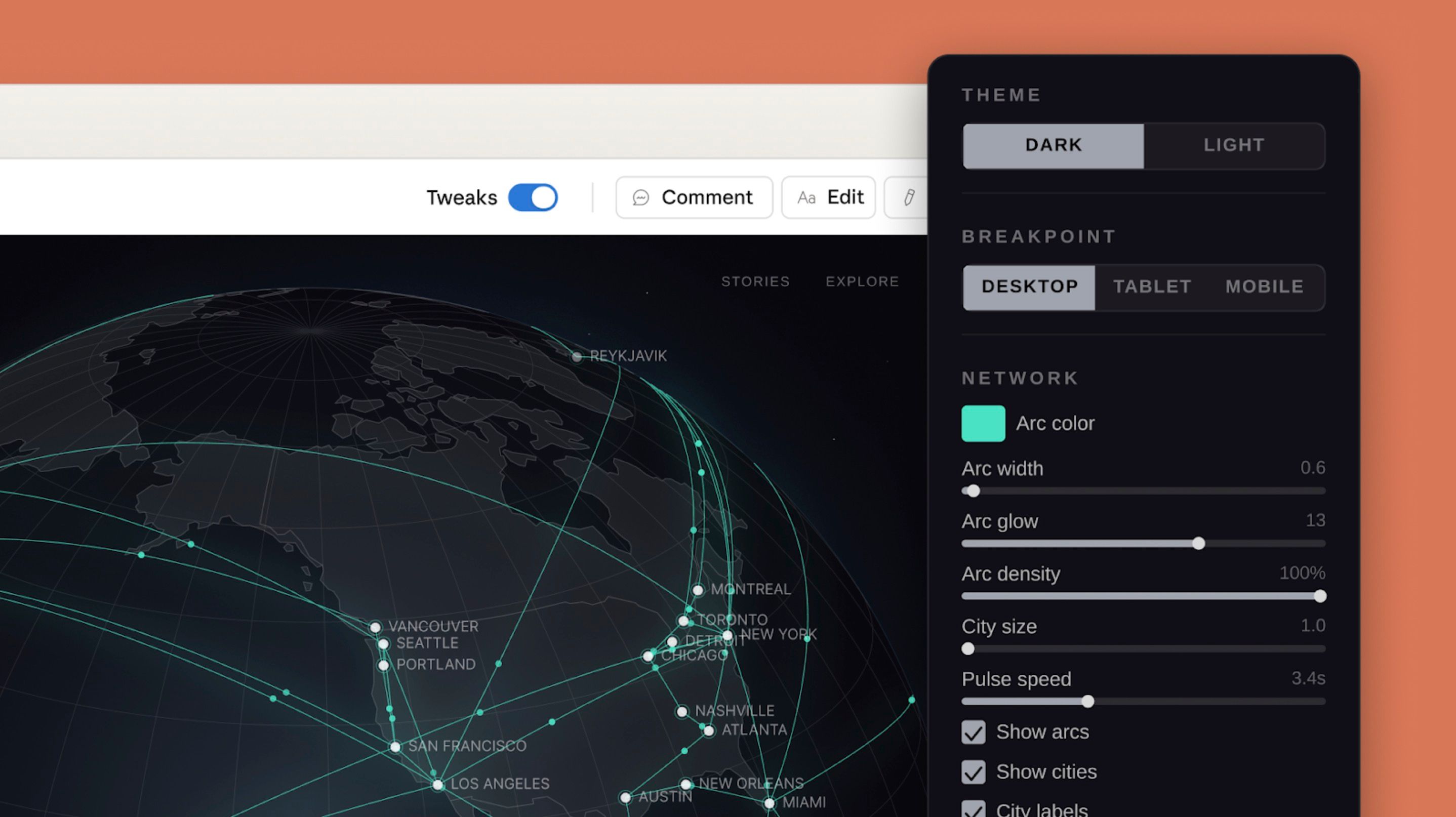
Small visual thing. Bigger conceptual thing. Generation is one mode. Refinement is another. Most AI design tools only do the first, which is why the outputs so often feel like lottery tickets. You keep rerolling the prompt until something lands. Parameterized refinement on the artifact lets you stop gambling and start designing.
The Live Demo#
Watch the first ninety seconds. Pay attention to when the generation ends and the tweaking starts. That transition is the product.
Who Actually Gets Disrupted#
Not Figma, not directly. The segment most affected is the in-between tier: Canva template designers, freelance deck builders, the whole cottage industry of "I'll make your pitch look good for two hundred dollars." That work compresses quickly when your customer can get 80 percent of the way there in five minutes of conversational editing with their own design system baked in.
The unserved middle was always where the pressure was going to land. Solo founders, PMs, non-designer ICs who needed design output and couldn't justify a Figma seat or a contractor budget. This is their tool. It fills a gap that didn't really have a good filler before.
The Catches#
Research preview, no timeline to GA. Enterprise customers default to off. Usage limits unspecified. Design system ingestion quality almost certainly varies with codebase hygiene and the staleness of your design files. If your "design system" is a Figma library from eighteen months ago and a Storybook half your team has stopped updating, the ingestion will produce a design system that looks like that.
And the competitive question stays open. Figma will ship something. Canva is already shipping something. Adobe has been shipping something for a while. The specific thing Claude has that's hard to replicate is the general-purpose reasoning stack underneath, which is why the design-system ingestion works at all. Whether that remains a durable moat in twelve months is not obvious.
The Takeaway#
The interesting move in Claude Design isn't the output format. It's the context ingestion. "Read what already exists, learn from it, produce new work consistent with it" is the pattern that makes AI design useful inside real companies instead of staying a toy.
If you're running a product team, the play isn't to adopt Claude Design tomorrow. It's to treat your design system as a machine-readable artifact. Because that's the difference now between AI output that works in your product and AI output that stays in a Google Doc.
Figma's stock will recover. The pattern underneath won't.