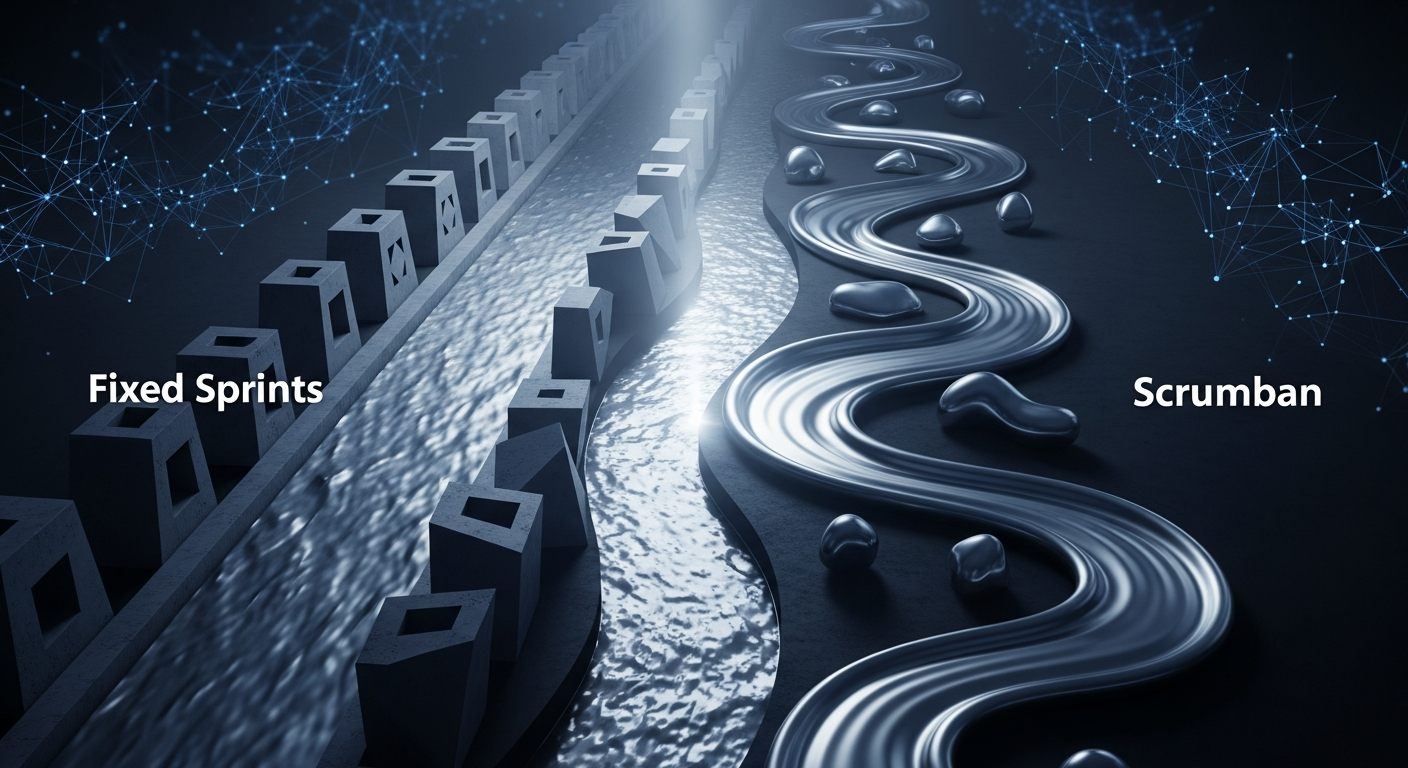
Fixed sprints made sense when the biggest variable in your project was developer velocity. That assumption doesn't hold anymore. When the AI landscape shifts meaningfully every few weeks, locking your team into a two-week sprint is less a planning tool and more a slow leak in your delivery pipeline.
The Scrum Problem Nobody Wants to Admit#
Here's something most engineering teams won't say out loud: they're not actually doing Scrum. They're doing something Scrum-like. Ceremonies get skipped, story points get inflated, and sprint goals get renegotiated mid-cycle whenever the business changes direction.
With AI-first development, that renegotiation happens constantly. A new model drops. A competitor ships something unexpected. The product owner pivots. Suddenly you're spending more energy defending your sprint backlog than shipping anything useful.
That's not a team discipline problem. That's a framework mismatch.
What Scrumban Actually Is#
Scrumban sits between Scrum and Kanban. It keeps the planning discipline and team rituals of Scrum but replaces the rigid sprint cadence with a continuous flow model pulled from Kanban. Work moves when the team is ready for it, not because a two-week clock ran out.
Atlassian describes it as a hybrid that "combines the structure of Scrum with the flexibility of Kanban." That framing is accurate but undersells the practical shift. The real change is in how planning gets triggered. Instead of planning on a fixed schedule, you plan when your backlog runs low. It's demand-driven, not calendar-driven.
For AI teams, that distinction matters enormously.
The Ceremonies Worth Keeping#
Dropping sprints doesn't mean dropping structure. Some ceremonies earn their place even in a flow-based system.
Daily Standups#
Keep them. They're still the cheapest and most effective tool for surfacing blockers and keeping the team pointed in the same direction. Fifteen minutes, three questions, move on.
Effort Estimation Sessions#
Keep these too, at least initially. Collectively sizing work isn't just about forecasting. It's how you ensure everyone on the team actually agrees on the implementation approach before anyone writes a line of code. It also keeps story point inflation in check. When estimates happen in a room together, it's harder to game.
Retrospectives#
Run them periodically, not necessarily on a strict two-week cycle. The goal is reflection and improvement. If the team has been heads-down for ten days and something clearly isn't working, that's when you call one. The trigger is usefulness, not the calendar.
Backlog Grooming#
This one actually becomes more important in a Scrumban setup, not less. The product owner carries real responsibility here. Work needs to be ready before it enters the team's flow, and the rate at which new items get released to the team should match what the team can realistically absorb. There's no universal rule for that rate. The product owner has to develop a feel for it and adjust continuously.
The Ceremonies You Can Let Go#
Fixed sprint planning meetings, sprint reviews tied to a cadence, and sprint retrospectives that happen whether or not there's anything meaningful to discuss. These lose their value fast when your priorities are shifting weekly in response to changes in the AI ecosystem.
When you're renegotiating the sprint backlog more often than not, you've already abandoned the premise of the sprint. You might as well be honest about that and design your process accordingly.
What Skeptical Managers Get Wrong#
The pushback I hear most often is that Scrumban is just undisciplined Scrum with a better marketing name. I get it. If Scrum is working well for your team, there's no reason to fix it.
But in my experience, most teams are already operating like Scrumban whether they call it that or not. Some ceremonies get dropped as "not important enough." Others happen but feel like afterthoughts. The team has quietly adapted Scrum to fit their actual reality. Scrumban just makes that adaptation intentional and principled.
That's not a lack of discipline. That's being honest about how work actually flows.
Where Scrumban Falls Short for AI Teams#
Scrumban doesn't automatically solve the problems that come with AI-assisted development. Specifically, when you're using AI agents to help write code, generate documentation, or plan implementation strategies, the framework itself isn't enough.
What I've found is that the guardrails matter more than the process. If AI is contributing to your delivery pipeline, you need:
- A well-documented definition of ready. Work should meet clear criteria before it enters the flow. Vague tickets produce vague output, from humans and AI alike.
- A clear definition of done. AI can ship fast. Fast and done are not the same thing. Explicit exit criteria keep the quality bar honest.
- Solid automation. Deployment pipelines, testing, the works. The faster the team moves, the more you need automation acting as a safety net underneath.
Without these, Scrumban on an AI-assisted team just means you're moving fast toward undefined outcomes. The flow model assumes work items are clean and well-understood. Making that true is the real work.
Is This the Right Move for Your Team?#
According to Wrike, Scrumban works best for teams that need "the structure of Scrum with the flexibility of a flow-based method," or teams transitioning from Scrum toward Kanban. That profile fits most AI-forward teams I've worked with or talked to.
You probably don't want to drop all structure and go full Kanban. The planning and alignment rituals still do real work. But you also can't keep pretending that fixed sprints make sense when the ground is shifting under you every two weeks.
Scrumban doesn't ask you to choose. It asks you to be deliberate about which parts of your process are load-bearing and which ones you're just running out of habit.
For most AI teams right now, that's exactly the right question to be asking. The teams that figure out a sustainable rhythm for AI-accelerated delivery will have a real edge. I don't think that rhythm looks like textbook Scrum. I think it looks a lot like what most honest teams are already doing when nobody's watching.