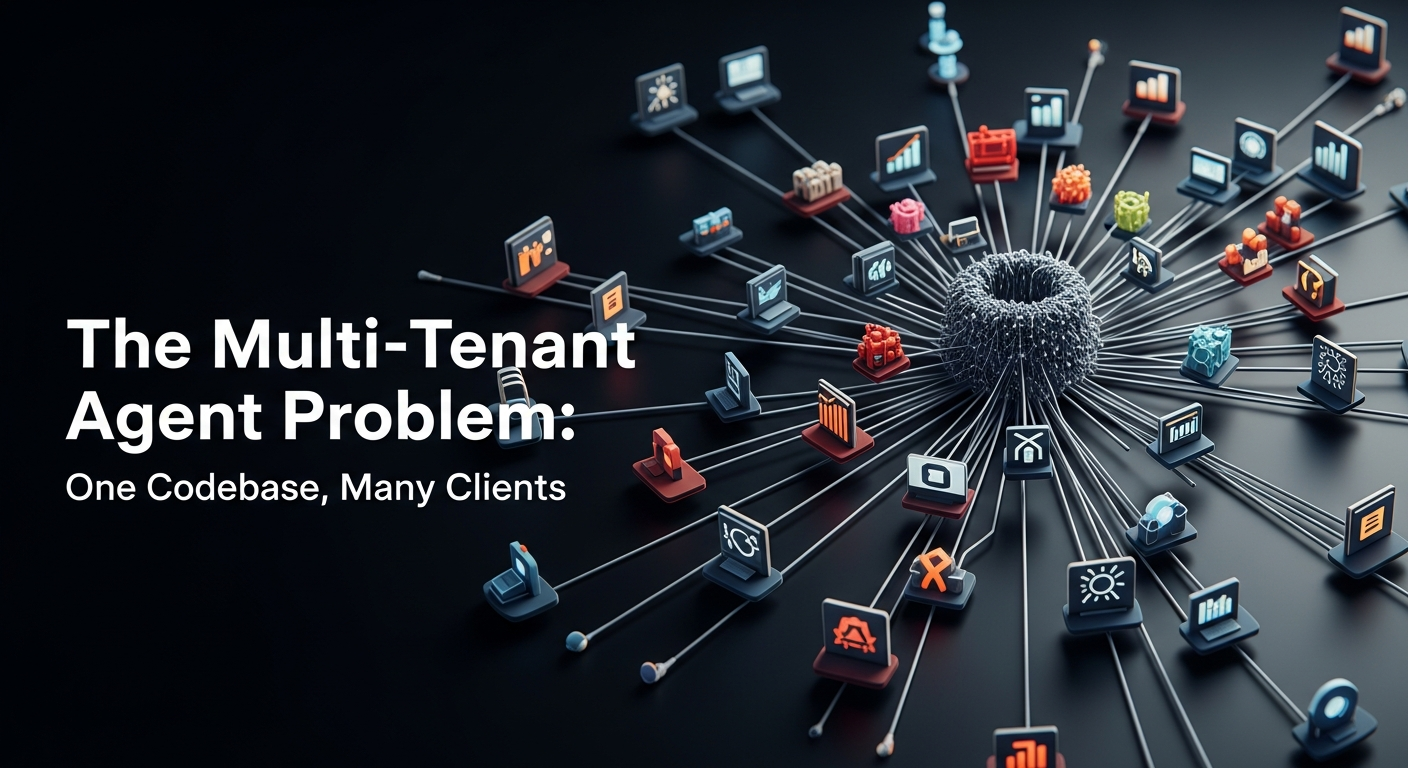
Most agent projects start simple. One team, one set of tools, one system prompt checked into a repo. Then a second client shows up, and you think: "I'll just copy the config." That's the moment the problem begins.
What Actually Breaks First#
When I first tried running the same agent codebase across multiple client workspaces, I didn't hit a deep architectural wall. I hit something embarrassingly mundane: config and environment variable collision. Client A's API key overwriting Client B's. A tool integration picking up the wrong base URL. An agent prompt meant for a fintech client leaking into a healthcare workspace.
It sounds trivial. It isn't. These collisions are silent in development and catastrophic in production. And they're the first sign that what you're building is no longer a single-tenant agent. It's a product.
That shift in framing matters. SaaS teams learned this the hard way over the past decade. Building for one customer is a project. Building for many is an entirely different engineering discipline.
The Config Schema is Your Foundation#
The cleanest thing I've done to manage per-tenant complexity is enforce a strict config schema. Every tenant gets a typed configuration object that travels with every agent invocation. Not environment variables. Not a flat JSON blob. A schema with known fields, validation, and defaults.
Think of it like a passport. The agent doesn't assume anything about who it's working for. It checks the passport, reads the instructions, and operates within those bounds. Client-specific system prompts, tool allowlists, memory namespaces, output constraints — all of it lives in that schema.
This keeps the complexity from spiraling. When a new client requirement comes in, you don't go hunting through the codebase. You add a field to the schema, handle it in one place, and move on.
What Goes in the Schema#
- System prompt overrides — client-specific instructions that shape agent behavior
- Tool access lists — which integrations this tenant is allowed to use
- Memory namespace — a unique key that scopes all persistent state to this tenant
- Secrets references — pointers to secrets manager entries, never the secrets themselves
- Logging and trace config — tenant ID, environment, verbosity level
Lessons from SaaS Multi-Tenancy: What Maps and What Doesn't#
Row-level security is a pattern every backend engineer knows. Tag every database row with a tenant ID. Filter on it everywhere. Never let a query run without a tenant scope. This translates directly and cleanly to AI agents. Any tool that reads or writes data needs to be tenant-scoped. Full stop.
What doesn't translate cleanly is stateful agent memory. In a traditional SaaS app, state lives in a database and you own the query. In an agent, memory can be implicit. The model carries context across turns. If you're not deliberate about where that context is stored and how it's namespaced, you end up with bleed. One client's prior conversation influencing another client's session.
Frameworks like Google's Agent Development Kit and Vertex AI Agent Engine are starting to address this at the runtime level. Vertex AI's managed agent infrastructure gives you deployment and execution boundaries that help enforce isolation. But you still have to design your memory layer intentionally. The platform won't do that thinking for you.
Secrets Handling#
Don't put secrets in the config schema directly. The schema holds a reference, something like secrets_manager_key: "client-a/openai-key". The agent runtime resolves that at invocation time. This means your config can be logged, versioned, and debugged without ever exposing credentials. It also means rotating a client's key doesn't require a redeployment.
Debugging Without Cross-Tenant Contamination#
When a client's agent does something wrong, you need to be able to trace exactly what happened for that tenant without touching anyone else's data. The pattern I rely on is tenant-scoped logging with trace IDs.
Every agent invocation gets a trace ID that includes the tenant identifier. Every log line emitted during that invocation carries that trace ID. When something breaks, you query by tenant and trace. You get a complete picture of what the agent saw, what it decided, and what it executed. Nothing from another tenant's run bleeds into that view.
This isn't a new idea. Distributed systems engineers have been doing trace-based debugging for years. The difference with agents is that the "trace" needs to include not just function calls and latencies, but also the inputs to the model, the tool calls it made, and the memory state it had access to. That's a richer trace and you have to plan for it from day one.
Platforms that give you structured observability out of the box, like what Vertex AI surfaces through Cloud Trace and Cloud Logging, save real time here. But you still need to inject the tenant context into every log emission yourself.
One Codebase, Real Isolation#
The goal isn't to run separate agent deployments per client. That's operationally expensive and defeats the whole point. The goal is one codebase, one deployment, with genuine isolation enforced at every layer: config, memory, tool access, secrets, and logging.
Teams moving from proof-of-concept to production with multi-tenant agents are hitting these problems right now. The frameworks have matured enough to support it. The runtime infrastructure exists. What's missing in most early architectures is the discipline to treat the tenant boundary as a first-class concern from the very first line of agent code.
If you're scoping an agent system that will serve more than one client, don't prototype it for one client and bolt on multi-tenancy later. I've seen that decision cost teams weeks of rework. Design the config schema first, establish your tenant scope logging before you write the first tool, and treat every piece of state as something that needs a namespace. The rest gets much easier.
I've found that teams who come from SaaS backgrounds actually have a head start here. The instincts are right. The specific implementations just need to be adapted for what agents do differently. If you're working through this architecture and want to compare notes, I'm genuinely interested in what you're running into.